
-1400x788.png)
Google AI Overviews now appear in more than 54% of all Google searches by volume. That means the majority of queries your potential readers type into Google now return an AI-generated answer before they ever see an organic result. On May 6, 2026, Google rolled out five significant updates to AI Overviews and AI Mode including more inline links placed directly next to relevant text, hover previews on desktop, and richer attribution for discussion sources. These changes are the biggest shift in how Google surfaces blog citations since AI Overviews launched. If your blog is not showing up in AI Overviews, you are invisible to more than half of Google's traffic. The good news: getting cited is not about gaming the system. It is about structuring factual, well-sourced content in a format that AI can easily extract and attribute. This guide covers exactly what changed in May 2026, why it matters for bloggers, and the seven tactics that consistently drive AI Overview citations.
What Are Google AI Overviews?
Google AI Overviews formerly the Search Generative Experience are AI-generated answer panels that appear at the top of Google search results. They summarize information from multiple web sources and present a synthesized response directly in the SERP. Google began rolling them out broadly in 2024, and by May 2026, they trigger for more than half of all search volume. That makes them the most important real estate shift in organic search since the introduction of featured snippets.
Unlike featured snippets, which pull a single block of text from one page, AI Overviews aggregate information from several sources and cite them inline. This is why the May 2026 update matters so much: Google added more inline links placed directly next to relevant text similar to how Wikipedia embeds citations dramatically increasing their visibility and the click-through potential for cited blogs.
The key distinction for SEOs: only 38% of pages cited in AI Overviews also rank in the top 10 for the same query, down from 76% just seven months earlier. You do not have to dominate SERPs to get cited. But you do have to produce the right kind of content.
The May 2026 Update: 5 Changes That Affect Your Blog
On May 6, 2026, Google announced five updates to AI Overviews and AI Mode that directly change how blogs get cited. Understanding each change tells you exactly where to focus your content optimization efforts.
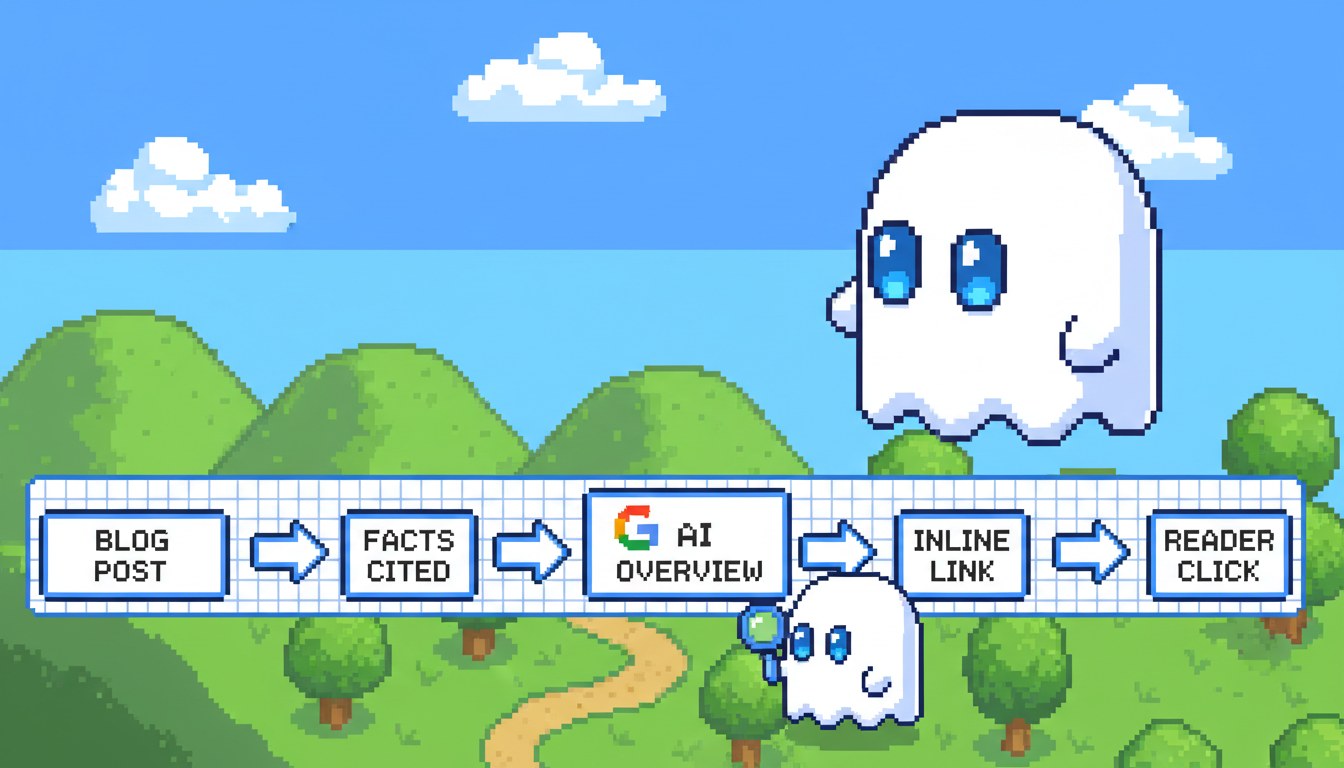
- More inline links. Google now places citation links directly next to the text they support inside the AI response not just in a collapsed cluster at the end. Your page title and meta description appear at the moment a reader is processing the relevant fact.
- Hover previews on desktop. Users can hover over any inline link and see a preview card showing your page title, URL, and a short excerpt. This makes your meta description directly influential on whether someone clicks through.
- Subscription access labels. News publishers and paywalled content now show a label. Free blogs without a paywall have a small but meaningful visibility advantage in this context.
- Richer discussion attribution. Reddit, forums, and community posts now receive "firsthand perspectives" labels and more prominent placement. If your content is being cited or discussed in communities, that signal matters more.
- "Explore new angles" links. At the end of AI responses, Google adds links to in-depth articles on different facets of the topic. Long-form content covering a subject comprehensively now has an explicit new entry point into AI Overviews.
For bloggers, items 1, 2, and 5 are the most actionable. Inline links make citations more visible. Hover previews reward well-written meta descriptions. The "explore new angles" section is a direct distribution channel for comprehensive posts.
Why Getting Cited in AI Overviews Matters
The traffic math has shifted hard. Research shows that AI Overviews cause a 46.7% relative decline in click-through rates queries that show an AI Overview see approximately 8% CTR versus 15% without one. That is a substantial organic traffic loss for any blog that has not adapted its strategy.
But there is an important counterweight. Pages that get cited inside AI Overviews see higher engagement from the clicks they do receive. Users who click through from an AI Overview citation are further along in their research, more qualified, and more likely to convert, subscribe, or return. The audience quality improves even as raw volume falls.
The new inline links from the May 2026 update amplify this effect. Previously, citations lived in a collapsed cluster at the bottom of the AI response easy to miss. Now they sit embedded next to the specific claim they support, visible to anyone reading that section of the AI answer. That placement changes the psychology: readers are looking at your link at exactly the moment they are processing information your blog can expand on.
For bloggers building topical authority in SEO, WordPress, Shopify, or any content niche, AI Overviews are the new organic distribution channel. Getting cited is not a vanity metric. It is a direct line to the 54% of searches that now surface AI Overviews before any organic blue link.
Top 7 Ways to Get Your Blog Cited in AI Overviews
- Write factual statements with source attribution every 150-200 words. AI extraction algorithms favor content that cites data. Pages cited by AI Overviews include 62% more facts than non-cited pages (Semrush research). Include statistics with their source in parentheses or via inline links not just in a bibliography at the end.
- Target informational keywords with AI Overview presence. AI Overviews trigger most often on informational queries "how to," "what is," and "best practices" searches. Nearly 80% of keywords that trigger an AI Overview have keyword difficulty below 40%, making them accessible even for blogs without massive authority.
- Structure content in extractable passages of 100-300 words. AI Overviews favor passages of 134-167 words, with about 62% of featured content falling between 100 and 300 words. Write H2 sections that open with a direct, self-contained answer before expanding into detail. Each section should be able to stand alone as a response to a query.
- Build genuine E-E-A-T signals. Google's AI systems favor content from demonstrably experienced authors. Include detailed author bios, cite primary sources rather than other blog aggregators, link to original research, and update content regularly to reflect current information.
- Use structured data especially FAQ, HowTo, and Article schema. Structured data does not directly guarantee AI Overview citations, but it helps Google's crawler understand your content structure and intent. FAQ schema is particularly effective because AI Overviews frequently extract question-and-answer content.
- Get discussed in forums and communities. Reddit is the most-cited domain across ChatGPT, Gemini, Perplexity, and AI Overviews. If your content is being referenced in community threads, that signals credibility to Google's AI systems. Engage in relevant subreddits and online communities authentically.
- Maximize content depth and length. Pages above 20,000 characters average 10.18 citations in AI Overviews, compared to just 2.39 for pages under 500 characters (Semrush data). Comprehensive coverage of a topic covering adjacent questions, edge cases, and FAQs significantly increases citation probability.
How to Optimize a Blog Post for AI Overview Citations: Step by Step
Step 1: Pick your keyword based on AI Overview presence. Use Semrush or Ahrefs to check whether your target keyword currently triggers an AI Overview. Both tools flag this in keyword reports. If your keyword shows an AI Overview, you have confirmed demand and a clear target to outperform.
Step 2: Analyze what the current AI Overview covers. Search your target keyword and read the AI Overview that appears. Note which sources are cited, what information is included, and more importantly what is missing. Your post should fill the gaps that existing citations leave open. Cover the sub-questions the AI response raises but does not answer.
Step 3: Write a direct answer in your opening 150 words. The AI extraction algorithm favors opening paragraphs that answer the query immediately. Do not bury the answer in paragraph four with a slow wind-up. State your core answer in the first 100-150 words, then expand with supporting evidence, examples, and context in the rest of the post.
Step 4: Add structured data markup. At minimum, implement Article schema with author, datePublished, and dateModified fields. For how-to content, add HowTo schema. FAQ schema is particularly effective AI Overviews frequently pull question-and-answer pairs, and marking them up explicitly makes extraction easier and more likely.
Step 5: Cite primary sources inline. Include at least three to five factual claims with source attribution ideally linking to studies, official Google documentation, or authoritative research rather than other blog roundups. Each cited fact increases your content's factual density, which is one of the strongest predictors of AI Overview citation.
Step 6: Write a structured FAQ section. A dedicated FAQ section at the end of your article serves double duty. It targets traditional featured snippets and gives AI Overviews a ready-made Q&A format to extract. Write each question exactly as users would type it into Google natural language questions, not keyword-stuffed phrases. Aim for five to eight questions with concise, direct answers.
Step 7: Set a refresh schedule and stick to it. AI Overviews favor recently updated content. Set a quarterly review for your most important posts add new statistics, update outdated claims, and reflect recent developments. Update the dateModified field in your schema each time. Freshness signals matter both for traditional rankings and for AI citation likelihood.
FAQ
What is the difference between Google AI Overviews and featured snippets?
Featured snippets pull one continuous block of text from a single page and display it verbatim. AI Overviews synthesize information from multiple sources, cite several pages inline, and generate a composed response rather than extracting raw text. AI Overviews also appear far more frequently in over 54% of searches by volume versus featured snippets which appear in roughly 8-10% of SERPs. And unlike featured snippets, getting cited in an AI Overview does not require ranking in position zero.
Does ranking in the top 10 guarantee you will be cited in AI Overviews?
No. As of 2026, only 38% of pages cited in AI Overviews also rank in the top 10 for the same query down sharply from 76% just seven months earlier. Google's AI systems draw from a wider pool of sources than traditional organic rankings. A blog post with excellent factual density, strong E-E-A-T signals, and clean structured data can get cited without a top-10 ranking. That is both the opportunity and the reason why GEO requires its own content strategy alongside traditional SEO.
How do the May 2026 AI Overviews changes affect click-through rates?
The new inline links embedded directly in AI Overview text make citations more visible and accessible than before. Previously, source links clustered at the bottom of the AI response easy to scroll past. Now they appear next to the specific claim they support, which increases their relevance at the moment of reading. The desktop hover preview feature also lets users see a source preview before clicking, improving click quality. Cited pages should see higher CTR from the May 2026 changes compared to the previous citation format.
Which types of blog content get cited most often in AI Overviews?
Informational content performs best across the board how-to guides, explainer articles, glossary posts, and research summaries. Queries with informational intent trigger AI Overviews at significantly higher rates than commercial or transactional queries. Long-form content above 10,000 characters with cited facts, clean H2 structure, and a dedicated FAQ section sees the highest citation rates. Data-heavy content posts that cite statistics with sources every 150-200 words — outperforms narrative content in AI extraction likelihood.
What is GEO and how is it different from SEO?
GEO stands for Generative Engine Optimization the practice of optimizing content specifically to be cited by AI systems including Google AI Overviews, ChatGPT, Gemini, and Perplexity. Traditional SEO focuses on ranking signals like backlinks, page speed, Core Web Vitals, and keyword density. GEO focuses on content structure, factual density, source authority, and passage-level extractability. In 2026, both matter: traditional SEO rankings still correlate with AI Overview citations, but they are no longer the only path to getting your content in front of AI-assisted search users.
Google AI Overviews have fundamentally changed where organic search traffic flows. With more than half of all searches now returning an AI-generated answer first and the May 2026 update making inline citations more visible than ever getting cited is no longer optional for blogs that depend on search traffic. The path in is clear: pick a keyword that triggers an AI Overview, write a direct-answer opening, pack in cited facts, add structured FAQ markup, and publish content deep enough to cover every angle. Bloggers who invest in GEO strategy now will own the new organic channel. Those who do not will watch their traffic curves flatten as AI answers the question before a user ever reaches their post.