

Google's 2026 core updates have been the most disruptive the SEO industry has seen in years. The March update alone shifted 79.5% of top-3 rankings higher volatility than any previous core update on record and pushed 24.1% of top-10 pages entirely out of the top 100. If your organic traffic collapsed in late March or May, you are not imagining things. This guide covers exactly what Google changed, which signals now carry the most weight, what types of sites were hit hardest, and the specific steps you need to take to recover and rebuild your rankings. Understanding the 2026 updates is not optional: Google has made clear this is the direction search is heading, and the next update is expected by June or July.
What Is a Google Core Update?
Google releases broad core updates several times per year to improve how the algorithm evaluates content quality and relevance across the entire index. Unlike targeted updates which address spam, links, or specific tactics core updates perform a comprehensive re-ranking of pages based on updated quality signals. Google does not penalize sites during core updates in the traditional sense; it recalibrates which content best satisfies a given query. In 2026, Google has already released two significant updates: a Discover-focused update in February, and the March 2026 core update, which wrapped up on April 8 after 12 days and became the most volatile core update ever measured. According to Search Engine Land, 79.5% of top-3 URLs shifted positions during this update far surpassing December 2025's 66.8%.
What Changed in Google's 2026 Core Updates
Three signals were significantly re-weighted in 2026, each targeting a different dimension of content quality.
Information Gain is now a top-tier signal. Google measures how much genuinely new knowledge your content adds relative to pages already ranking for the same query. Pages that restate existing information without first-hand data, unique analysis, or original research lost rankings fast. The winners: sites with proprietary data, expert-authored insights, and content that goes meaningfully beyond what a user could find in the current top 5.
E-E-A-T now applies across every niche. Experience, Expertise, Authoritativeness, and Trustworthiness previously carried the most weight in health, finance, and legal content. The 2026 updates extend this standard to every category. AI-generated or anonymous content without verifiable author credentials now faces a structural disadvantage. Google's systems can distinguish between content backed by real expertise and content that only mimics the structure of expert writing.
Core Web Vitals thresholds tightened. LCP (Largest Contentful Paint) now has a firm 2-second threshold for a "good" score. Sites that previously hovered between "needs improvement" and "good" are experiencing ranking consequences. Page experience and content quality are now evaluated together neither compensates fully for the other.
Which Sites Were Hit Hardest
The March 2026 update was particularly brutal for intermediary sites websites that exist between a user and a direct answer. Affiliate review aggregators, comparison hubs, coupon portals, generic topic directories, and content farms built primarily around ad revenue all lost significant ground. Google is routing users past these sites more aggressively than at any point in the past decade. If your site does not provide a primary source of truth on its topic, you are structurally at risk.
Shallow topic coverage also took significant hits. Sites publishing lightly across hundreds of topics performed far worse than sites covering one subject comprehensively across multiple content formats. Google is rewarding topical authority: the more completely you cover a subject from beginner guides to advanced how-tos to case studies the more compounding ranking advantage you accumulate. According to Quantifimedia, content quality signals in 2026 now separate expert-written content from mass-produced AI output more precisely than at any previous point in search history.
Top 7 Signs Your Site Was Hit by a Google Core Update in 2026
- Traffic dropped sharply in late March or mid-May and has not recovered after 4+ weeks
- Informational query rankings collapsed while branded search held steady
- Pages with no listed author or thin content lost the most visibility
- Competitor pages with stronger bylines and more detailed content moved ahead of yours
- Pages with LCP scores above 2.5 seconds dropped regardless of content quality
- AI-generated content without expert review or first-person data was demoted sitewide
- High-traffic pages aggregating and summarizing other sources declined the most
How to Recover from a Google Core Update in 2026
Recovery from a core update requires a content-first audit rather than a technical fix. Unlike spam or manual penalties, there is no single switch to flip. The process takes months, but starting immediately gives you the best chance of recovery by the next update cycle expected in June or July 2026.
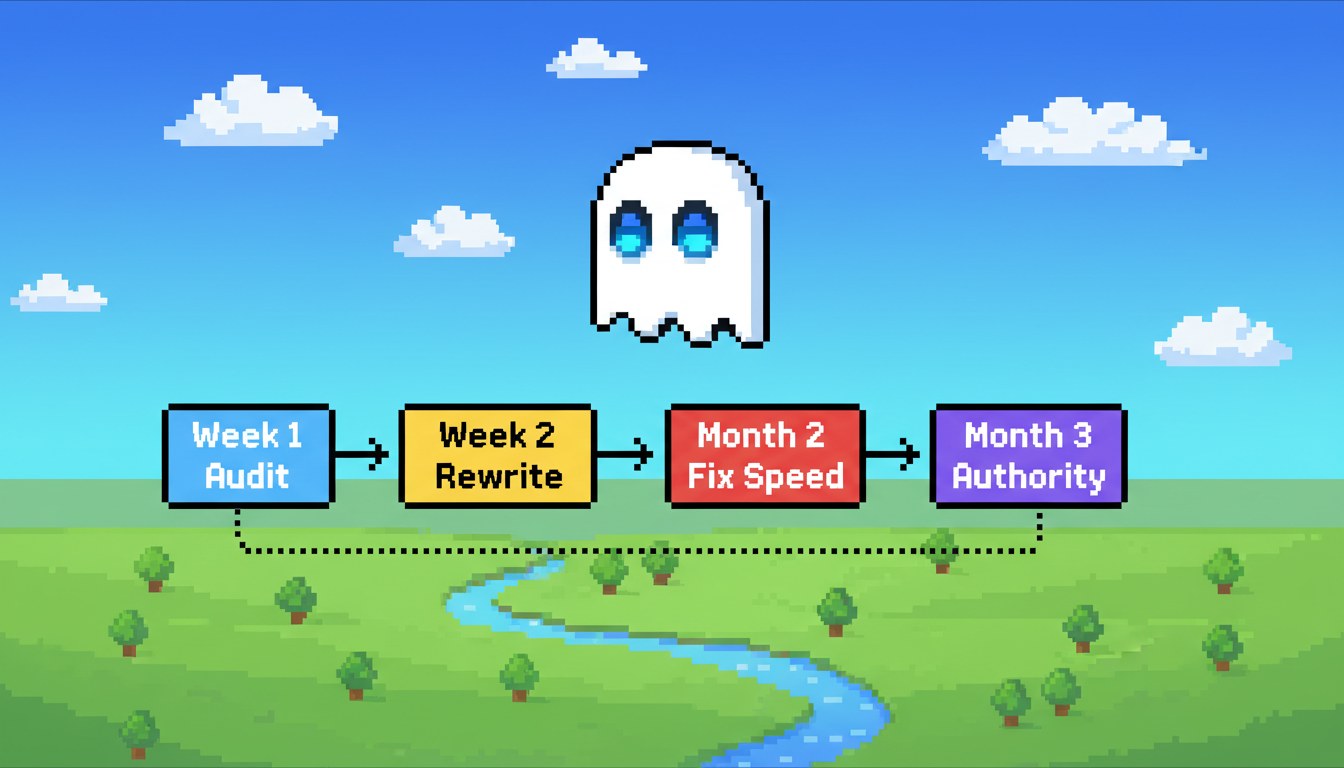
Weeks 1–2: Identify affected pages. Pull your Google Search Console data and filter for pages that lost significant clicks after March 27. Sort by largest drop. These become your priority pages for the next 90 days.
Weeks 2–3: Audit for Information Gain. For each affected page, ask: does this content add something that no other page in the top 10 provides? If not, it is a candidate for a full rewrite. Thin pages under 800 words, no original data, no expert attribution should be expanded significantly or consolidated with stronger adjacent content.
Weeks 3–4: Add author credentials. Every significant piece of content needs a named author with a byline, bio, and topic-relevant credentials. Link author bios to LinkedIn or professional profiles. This is a direct E-E-A-T signal that Google evaluates on every page crawl.
Month 2: Fix Core Web Vitals. Run the Core Web Vitals report in Google Search Console. Any pages with LCP over 2 seconds need performance work. For WordPress sites, this typically means upgrading hosting, enabling image lazy-load, and switching to a performance-optimized theme. Use PageSpeed Insights to identify specific bottlenecks per page.
Months 2–3: Build topical depth. Transform isolated posts into content hubs. If you wrote one article on a subject, build around it: add an overview guide, supporting how-to posts, an FAQ page, and a case study. This signals topical authority at a structural level. Google rewards sites that own a topic, not sites that have touched it once.
FAQ
Does Google announce core updates in advance?
No. Google announces core updates on the day they begin rolling out, via the Google Search Central blog and the @Google_SearchC account on X. There is no advance warning. Following these official channels is the fastest way to know when a new update starts and to immediately begin monitoring your traffic and rankings.
How long does it take to recover from a Google core update?
Recovery typically takes until the next core update roughly 3 to 6 months, depending on how quickly and substantially you improve your content. Sites that make significant upgrades sometimes see partial recovery within 4 to 8 weeks, particularly on pages where competitors have not improved.
Will reverting recent changes help my rankings?
Rarely. Core updates are not punishments for recent actions. Google re-evaluated your content quality against a new standard. Reverting changes does not address the underlying issues that caused the drop. Focus on forward improvements: rewriting thin content, adding author expertise, building topical depth not undoing past decisions.
Does AI content automatically hurt rankings in 2026?
No but AI content without expert review and genuine original insight does. Google evaluates whether content demonstrates real experience and expertise, not whether it was written by a machine. AI-assisted content that is reviewed, enriched with first-hand data, and attributed to credible authors performs well. Mass-produced AI content that rehashes existing information without adding value does not.
What is "Information Gain" and how do I improve it?
Information Gain is a ranking signal measuring how much new, unique knowledge a page adds compared to pages already ranking for the same query. To improve your score: incorporate original research, proprietary data, expert quotes, personal case studies, or specific insights your competitors have not covered. The goal is to make your content the one page in the results that a user would genuinely lose something by not reading.
Google's 2026 core updates are not a temporary fluctuation they represent a structural shift in how search quality is evaluated. The sites that recover fastest treat their content like a product: investing in genuine expertise, measurable accuracy, and user satisfaction over keyword density. Audit your top-traffic pages now, add author credibility, and build topical depth before the next update arrives. The window to act is open use it.