
Dominate the SERPs: The Ultimate Backlink Strategy for World Cup Blogs
The FIFA World Cup is more than the world's biggest football tournament. It's one of the largest online events, generating billions of searches for match previews, player statistics, fixtures, predictions, team news, and breaking stories. For sports bloggers, football journalists, publishers, and affiliate websites, this surge in search demand presents a unique opportunity to attract highly engaged audiences, build long-term authority, and significantly increase organic traffic.
Ranking during the World Cup, however, is far more competitive than publishing regular sports content. You'll be competing with established publishers like ESPN, BBC Sport, Sky Sports, The Athletic, and FIFA's official website, all of which have years of authority, experienced editorial teams, and millions of backlinks.
Fortunately, authority isn't built on domain size alone. A strategic backlink campaign, combined with high-quality content and timely publishing, can help independent sports blogs compete for valuable World Cup keywords. If you're also optimizing your content for AI-powered search experiences, Ghost.blog's How to Build a Winning SEO Strategy for Google AI Overviews provides valuable insights into creating structured, trustworthy content that performs well in both traditional and AI-driven search.
Instead of chasing hundreds of low-quality backlinks, focus on earning links from relevant, authoritative websites that reinforce your expertise in football and sports journalism.
Key Takeaways
- Begin your backlink campaign several months before the tournament starts.
- Focus on earning editorial backlinks rather than purchasing links.
- Publish original research, statistics, and interactive tools.
- Use breaking news to attract natural mentions from journalists.
- Build topical authority with interconnected football content.
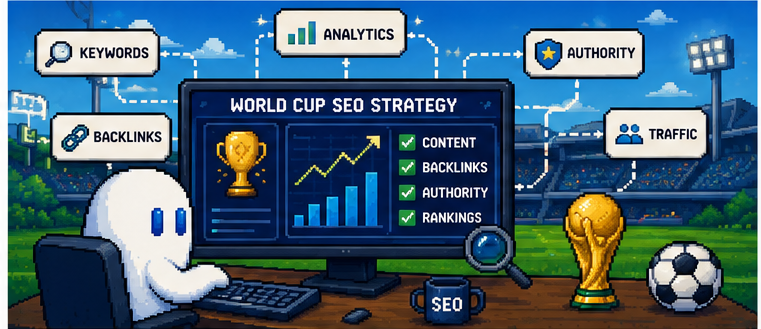
World Cup SEO Strategy
Why World Cup SEO Is Different
Search engine optimization during the FIFA World Cup behaves very differently from traditional evergreen SEO. Search demand changes almost hourly, news develops rapidly, and Google prioritizes the freshest, most authoritative information available.
Understanding these differences allows publishers to prepare content before competitors react.
Google Prioritizes Fresh Content
Major sporting events generate enormous amounts of new information every day. Match results, injuries, transfers, controversial referee decisions, tactical changes, and player interviews all influence search behaviour.
According to Google's Search Essentials: Creating Helpful, Reliable, People-First Content, websites that publish accurate, regularly updated, and genuinely helpful content are more likely to remain visible as search trends evolve.
This means your website should consistently deliver:
- Fresh articles
- Updated statistics
- Accurate match information
- Fast indexing
- Editorial backlinks
- Regular publishing
The faster respected websites reference your content, the stronger your authority becomes.
World Cup Search Traffic Is Seasonal
Unlike evergreen topics, World Cup traffic follows a predictable lifecycle.
Six to Twelve Months Before
Interest begins growing as teams qualify and fixtures become available.
One to Two Months Before
Fans begin searching for squad announcements, predictions, travel guides, ticket information, fantasy football advice, and betting insights.
Tournament Period
Search demand reaches its highest point, with millions of searches every hour.
After the Final
Search volume decreases rapidly, although historical analysis, player transfers, and tournament statistics continue attracting visitors.
Because backlinks take time to influence rankings, successful campaigns begin long before the opening match.
E-E-A-T Is More Important Than Ever
Google evaluates sports content using Experience, Expertise, Authoritativeness, and Trustworthiness.
For football publishers, strong trust signals include backlinks from:
- Football associations
- Sports journalists
- Universities
- Sports research organizations
- Football clubs
- Trusted sports blogs
These editorial links demonstrate credibility far more effectively than hundreds of low-quality directory submissions.
Backlink Strategies That Actually Work
Building backlinks during the World Cup requires creativity rather than mass outreach. The best campaigns create resources that journalists, bloggers, and football fans genuinely want to reference.
1. Publish Original Research
Data-driven content consistently attracts editorial backlinks because journalists need reliable statistics to support their reporting.
Instead of publishing another prediction article, create something original.
Ideas include:
- Tournament simulations
- Player performance analysis
- Squad value comparisons
- Historical rankings
- Fan surveys
- Injury impact reports
- Possession statistics
For example:
"Brazil has a 34% chance of winning the World Cup based on 10,000 simulated tournaments."
Unique research provides journalists with valuable evidence, making your content much more likely to earn natural backlinks.
2. Create Interactive Linkable Assets
Interactive content naturally earns links because people enjoy sharing useful tools.
Popular examples include:
- Interactive World Cup brackets
- Printable wall charts
- Match prediction tools
- Group qualification calculators
- Sweepstakes generators
- Stadium maps
- Time-zone converters
These resources frequently attract backlinks from:
- Football blogs
- News websites
- Fan communities
- Office competitions
- Forums
- Educational websites
The more practical your resource is, the more backlinks it can earn without active outreach.
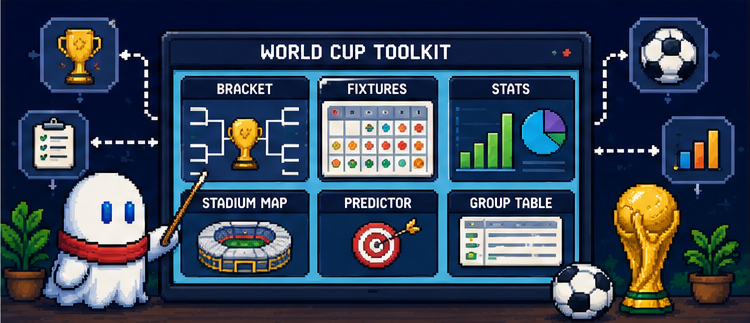
Interactive World Cup Toolkit
3. Focus on Localized Content
Every participating nation has its own football community, journalists, and local publishers.
Rather than producing generic tournament coverage, create specialized content tailored to individual countries.
Examples include:
- Morocco's defensive tactics
- Japan's emerging talent
- Argentina's attacking patterns
- England's qualification history
- Brazil's tactical evolution
Localized content often receives far more attention from regional journalists than broad tournament summaries.
4. Newsjack Breaking Stories
The World Cup creates headlines every single day.
Unexpected results, controversial VAR decisions, injuries, tactical innovations, and dramatic finishes all generate enormous search interest.
Using Google Trends, publishers can identify rapidly growing search topics and produce expert analysis while public interest is still increasing.
The most successful newsjacking workflow looks like this:
Monitor breaking news.
Research the story.
Publish expert analysis within one hour.
Share it across football communities.
Reach out to journalists covering the event.
Speed often determines who earns the backlink.
5. Broken Link Building
One of the most effective yet overlooked link-building strategies is replacing outdated resources with better, more relevant content.
Many websites still link to World Cup pages from previous tournaments, including outdated schedules, fixtures, stadium guides, team previews, and prediction tools. These pages often contain broken links or obsolete information that no longer serves users.
Instead of creating completely new topics, identify these outdated resources and publish updated versions with current statistics, schedules, and insights. Then, reach out to websites linking to the old content and suggest your article as a replacement.
Before contacting publishers, review the linking opportunities using Ahrefs' Link Building Guide, which explains how to identify high-value backlink prospects and create replacement content that naturally earns editorial links.
This strategy benefits everyone involved. Website owners fix broken resources, readers receive accurate information, and your website gains relevant backlinks.
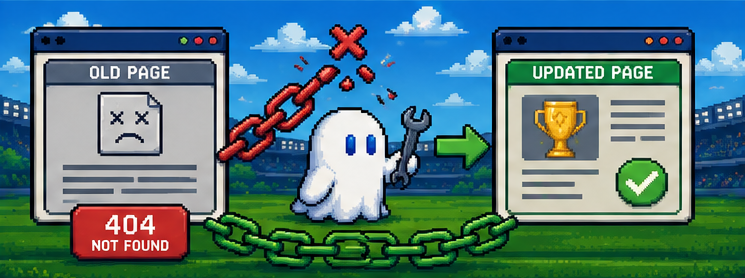
Broken Link Outreach
Comparing the Best Link Building Strategies
Strategy | Difficulty | Authority Potential | Speed | Best Use Case |
|---|---|---|---|---|
Digital PR | High | Very High | Slow | Building long-term authority |
Interactive Assets | Medium | High | Medium | Earning natural backlinks |
Local Outreach | Medium | Medium-High | Medium | Country-specific visibility |
Newsjacking | Medium | High | Very Fast | Live tournament coverage |
Broken Link Building | Easy | Medium | Fast | Replacing outdated resources |
Each strategy contributes differently to your SEO goals. Combining several approaches creates a stronger and more sustainable backlink profile than relying on just one.
World Cup Backlink Campaign Timeline
Planning ahead is one of the biggest advantages in World Cup SEO. Backlinks take time to influence rankings, so waiting until the tournament begins is often too late.
Phase 1: Six to Twelve Months Before
Focus on building authority with evergreen content.
Publish:
- Stadium guides
- Tournament history
- Team profile pages
- World Cup records
- Qualification analysis
- Time-zone converters
- Host nation guides
Begin guest posting, digital PR campaigns, and broken link outreach during this phase.
Phase 2: One to Five Months Before
This is the ideal time to launch content designed specifically to earn backlinks.
Create:
- Interactive brackets
- Printable wall charts
- Prediction tools
- Original research
- Infographics
- Statistical reports
As your content library grows, automation can help manage publishing schedules, internal linking, and content updates. Ghost.blog's Mastering SEO and Workflow Automation with n8n demonstrates how workflow automation can simplify large-scale content publishing while maintaining consistency.
Phase 3: During the Tournament
This is where speed becomes your biggest competitive advantage.
Every day:
- Monitor breaking news
- Publish expert analysis
- Update existing articles
- Promote content on social media
- Contact journalists
- Refresh statistics
Timely, accurate reporting can often outperform larger publishers when combined with authoritative backlinks and fresh content.
Phase 4: After the Tournament
The tournament may end, but your SEO strategy shouldn't.
Continue building authority by:
- Adding internal links to evergreen football content
- Updating successful articles for future tournaments
- Refreshing statistics and historical records
- Redirecting temporary pages using 301 redirects
- Repurposing content into infographics, videos, and newsletters
This preserves link equity and keeps your content valuable long after the final whistle.

World Cup SEO Timeline
Common Link Building Mistakes to Avoid
Even well-planned campaigns can struggle if they rely on outdated SEO tactics.
Avoid these common mistakes:
- Buying low-quality backlinks or participating in private blog networks.
- Overusing exact-match anchor text.
- Ignoring topical relevance.
- Publishing duplicate content.
- Waiting until the tournament starts to build backlinks.
- Neglecting internal linking.
- Failing to update statistics and match information.
- Prioritizing quantity over quality.
Strong backlinks come from trust, relevance, and valuable content—not shortcuts.
Essential Tools for World Cup Link Building
Building an effective backlink strategy becomes much easier with the right tools.
Recommended resources include:
- Ahrefs or Semrush for backlink analysis and competitor research.
- Google Trends for discovering emerging football topics and breaking stories.
- Hunter.io for finding journalist contact information.
- BuzzStream or Pitchbox for managing outreach campaigns.
- Canva or Datawrapper for creating shareable graphics and infographics.
Using these tools together allows you to identify opportunities, monitor competitors, and build relationships with publishers more efficiently.
Frequently Asked Questions
When should I start building backlinks for World Cup content?
Ideally, begin six to twelve months before the tournament. Building authority early gives search engines enough time to recognize your website and improves your chances of ranking when search interest peaks.
What types of backlinks are most valuable?
Editorial backlinks from trusted sports websites, football clubs, journalists, universities, and respected publications carry far more value than large numbers of low-quality directory or forum links.
Is newsjacking a good backlink strategy?
Yes. Publishing timely, well-researched analysis around breaking World Cup stories can attract natural backlinks from journalists, bloggers, and sports communities, especially when your content provides unique insights.
Can interactive tools help earn backlinks?
Absolutely. Interactive brackets, prediction tools, qualification calculators, printable wall charts, and stadium guides are highly shareable resources that naturally attract links from sports blogs, news outlets, and fan communities.
Should I buy backlinks to rank faster?
No. Purchasing low-quality backlinks or using private blog networks can violate Google's guidelines and harm your website's long-term performance. Focus on earning relevant, high-quality backlinks through valuable content and genuine outreach.
Final Thoughts
A successful World Cup backlink strategy isn't built overnight. It combines long-term planning, original content, digital PR, timely reporting, and consistent outreach to earn backlinks from trusted sources.
Instead of chasing hundreds of links, focus on building resources that journalists, bloggers, and football fans genuinely want to reference. Interactive tools, original research, localized content, and expert analysis provide lasting value that continues attracting backlinks well beyond the tournament.
The next FIFA World Cup will bring another surge of global search interest. By preparing early and investing in high-quality content today, you'll be in a stronger position to compete with established publishers, increase your search visibility, and build lasting authority that extends far beyond the final whistle.